
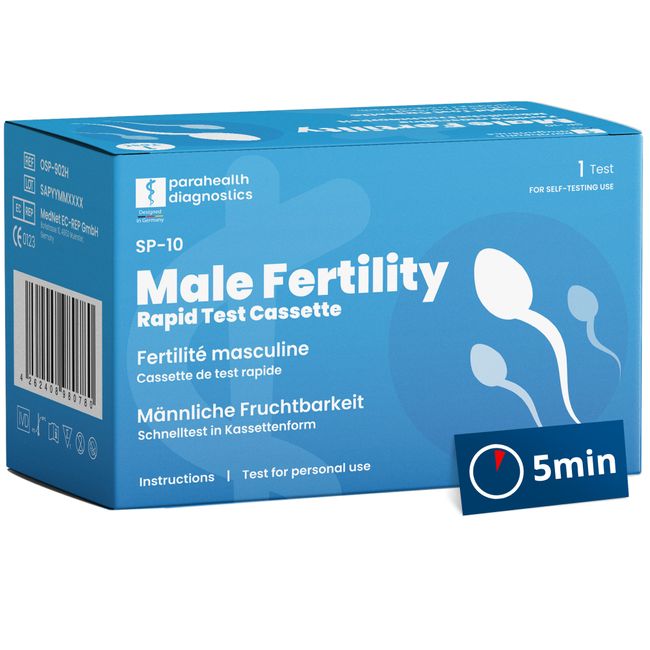
A home sperm test can offer a private first indication of sperm concentration, while a medical semen analysis provides a broader assessment. The home test does not evaluate every factor involved in fertility and cannot confirm fertility or infertility. The most useful choice depends on whether you want initial orientation or a more comprehensive medical evaluation.
Home sperm test or semen analysis: the short answer
A home sperm concentration test is a practical first step when you want a discreet result in your own environment. It shows whether the measured concentration is at or above the test's stated threshold or below it. A medical semen analysis examines several semen parameters and places the findings in clinical context.
These options are not competitors. They answer different questions. A home test can help you decide whether further assessment would be useful, while a semen analysis can provide the broader picture when concerns remain.
What a home sperm test measures
Most cassette-based home tests focus on sperm concentration. Depending on the test principle, they detect a sperm-related marker and return a threshold result. This can be helpful because it turns one measurable parameter into a clear first point of orientation.
A threshold result, not a full fertility assessment
A threshold divides the result into categories defined by the specific test. It is not a universal boundary between fertile and infertile. Fertility depends on several factors involving both partners, and conception cannot be predicted from sperm concentration alone.
For men who want a private first check, the parahealth diagnostics male fertility test for home use assesses sperm concentration against its stated threshold. The product page contains current availability, kit details, and the exact instructions for use.
What a home sperm test cannot assess
A concentration test does not provide the same information as a laboratory semen analysis. Depending on the product, it generally does not assess:
- sperm movement or progressive motility;
- sperm shape or morphology;
- the total number of sperm across the full ejaculate;
- semen volume, pH, liquefaction, or other laboratory characteristics;
- hormonal, anatomical, genetic, or partner-related factors.
For this reason, a result at or above the threshold is encouraging only for the parameter measured. It does not guarantee conception. A result below the threshold is not a diagnosis of infertility.
Home sperm test and medical semen analysis compared
| Question | Home sperm concentration test | Medical semen analysis |
|---|---|---|
| Where is it performed? | Privately at home | Through a medical practice or laboratory |
| What does it examine? | A defined concentration threshold | Several semen parameters, including concentration, total count, movement, shape, volume, and other characteristics |
| What kind of result is provided? | A threshold category defined by the product | Laboratory measurements interpreted together and in clinical context |
| What is its strength? | A discreet and accessible first orientation | A broader assessment that can guide further medical evaluation |
| What is its main limitation? | It does not assess every fertility-related parameter | One analysis still cannot by itself prove fertility or infertility |
The World Health Organization's laboratory manual standardizes how semen is examined, but its reference distributions are not a simple fertile-versus-infertile dividing line. Medical findings need to be interpreted together with history, examination, and other relevant factors.
How to interpret a home result calmly
Always use the categories and read window in the instructions supplied with the specific product. Procedures, thresholds, preparation steps, and result displays can differ between tests.
If the result is at or above the threshold
This is an encouraging result for the concentration parameter measured. It does not assess movement, shape, or every other factor involved in conception. If concerns remain, a medical assessment can still provide useful context.
If the result is below the threshold
One result does not establish infertility. Follow the repeat-testing instructions supplied with the test. If a low result repeats, discuss it with a doctor or another qualified medical professional. A laboratory semen analysis can examine the finding more broadly.
If the result is invalid
An invalid result means the test did not run correctly. Repeat it with a new test and follow the current instructions carefully. Do not interpret a cassette when the required control indicator is absent.
When medical assessment is sensible
Medical advice is useful when a home result is repeatedly below the threshold, when fertility concerns continue, or when pregnancy has not occurred despite regular unprotected intercourse. Assessment may also be sensible earlier when there is a relevant medical history, previous testicular surgery, cancer treatment, known hormonal or genetic conditions, or problems with ejaculation or erection.
Seek prompt medical advice for pain, swelling, a lump, or other noticeable changes in the testicular area. A urologist, andrologist, or fertility specialist can combine a semen analysis with medical history, examination, and additional tests when necessary.
Choosing the next useful step
If you want a private first orientation, a home concentration test can be a straightforward and positive starting point. If the result raises questions or you want a fuller assessment from the beginning, a medical semen analysis is the more informative choice. Neither option should be treated as a verdict on you or your fertility.
Frequently asked questions
Can a home sperm test confirm fertility?
No. It provides information about the parameter measured, usually sperm concentration, but it cannot confirm fertility or guarantee conception.
What is the difference between a sperm test and a semen analysis?
A home concentration test provides a threshold result. A medical semen analysis evaluates several semen parameters and interprets them within a broader clinical assessment.
Is a result above the threshold always normal?
It is encouraging for the measured concentration threshold, but movement, shape, total sperm number, semen characteristics, and factors involving both partners also matter.
What should I do after a result below the threshold?
Follow the repeat-testing instructions for the specific product. If a low result repeats, discuss it with a doctor or another qualified medical professional.
When should male fertility be assessed medically?
Assessment is sensible when concerns persist, a home result is repeatedly low, pregnancy does not occur despite regular unprotected intercourse, or symptoms and relevant risk factors are present.
Can a semen analysis prove infertility?
No single semen analysis can by itself prove fertility or infertility. The findings are interpreted together with medical history, examination, possible repeat testing, and factors involving both partners.

Leave a comment
All comments are moderated before being published.
This site is protected by hCaptcha and the hCaptcha Privacy Policy and Terms of Service apply.